
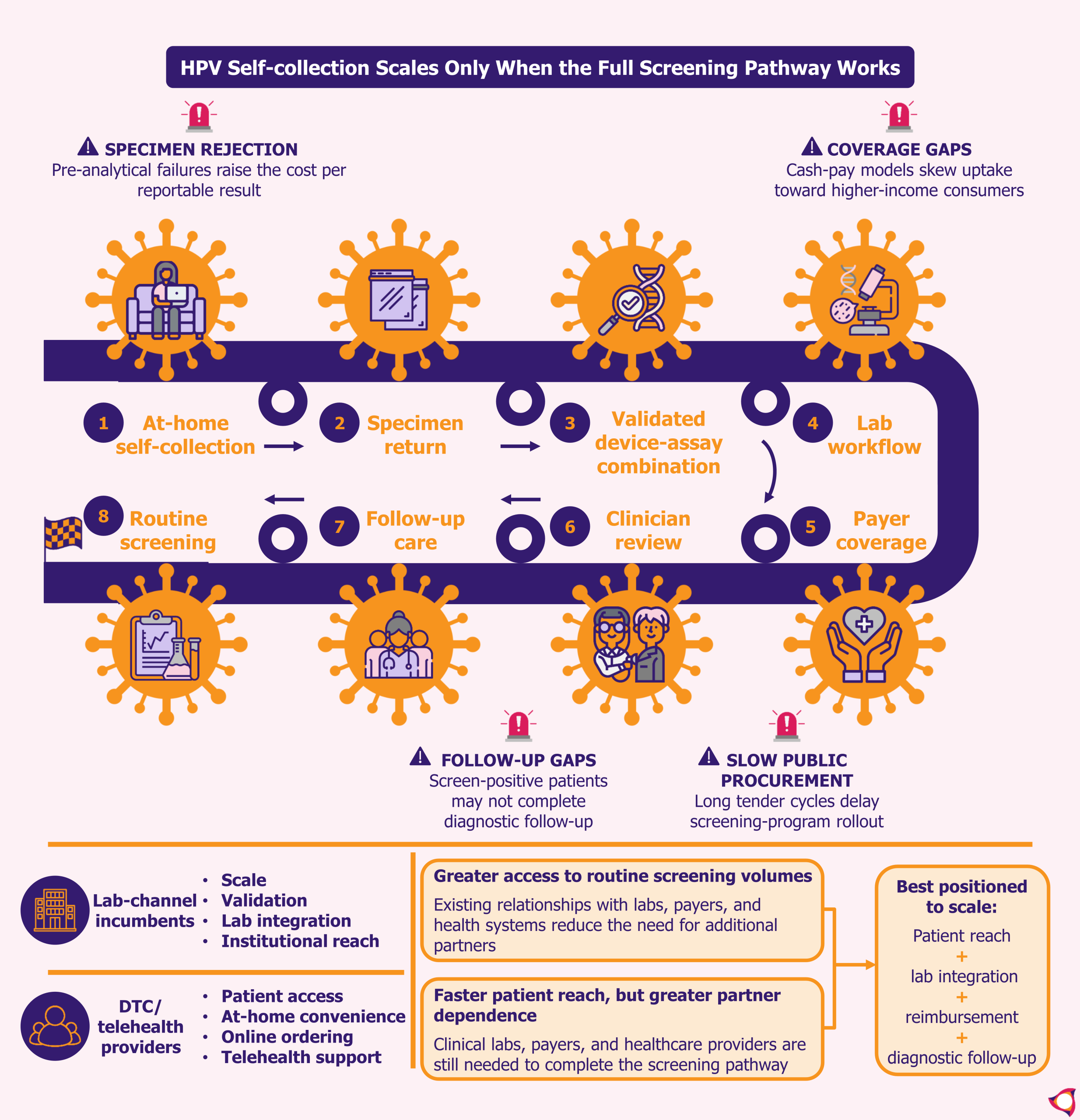
Routine cervical cancer screening has declined, particularly among younger women and underserved groups. HPV self-collection might help reverse this by offering privacy and convenience outside clinics. Major diagnostics companies and telehealth providers are entering, although selling kits alone will not lead to broad use. Easier collection still has to link into laboratory processing, payer coverage, triage, and colposcopy referral for HPV-positive women.
Established diagnostics companies have an early advantage
Several major companies, including Roche, Qiagen, and Hologic, have entered this space through health-system and laboratory channels rather than standalone consumer sales. They already have working relationships with laboratories, providers, and screening programs. That shortens their route through public procurement and reimbursement, and into routine laboratory workflows.
Established diagnostics companies are moving into at-home collection. In 2026, the FDA cleared the Onclarity Self-Collection Kit for home collection and approved the BD Onclarity HPV Assay for testing vaginal specimens self-collected at home. Both products are now part of Waters Corporation’s diagnostics portfolio following its acquisition of BD’s Diagnostic Solutions business. The decisions show that specimen collection can move into the home while testing remains in established clinical laboratories. For now, these companies have an edge because their assays already fit laboratory workflows, although long-term growth still depends on reimbursement and government tender cycles.
Related reading:
MDx Testing Moves Closer to Patients as Labs Lose Their Central Role
Consumer-facing companies, such as TBD Health and Teal Health, target women who avoid clinics due to discomfort, limited access, or lack of time. They can reach patients faster than public programs because they can market online, use telehealth, and ship kits directly. Return rates and payer coverage can still curb use. DTC providers also need triage and referral after a positive result.
As health-system and direct-to-consumer models blur, telehealth providers such as TBD Health now combine in-clinic consultations with at-home kits. This widens reach, but adds a clinician order and result review, lab processing, insurance billing, and follow-up referrals.
Broad use will require simple patient collection, payer coverage, and little extra work for laboratories and clinicians.
At-Home HPV Self-Collection Favors Established Diagnostics Companies by EOS Implicium
Regulation, coverage, and laboratory fit shape HPV self-collection growth
Even with demand rising, regulation and coverage set the pace, along with laboratory handling and clinical follow-up.
Uneven clearance and coverage slow the shift to standard care
Regulators have approved self-collection in different settings. But many telehealth and kit companies have no authorization covering a self-collected specimen on the assay they use. In the USA, Roche and BD first showed the healthcare-setting route, while Teal and Waters have since shown that at-home collection can also move through FDA review.
In Europe, IVDR clearance decides both market entry and lab adoption. Laboratories adopt self-collection more easily when the device, assay, and workflow already fit regulated systems. That works in favor of the established diagnostics companies already supplying them. Smaller self-collection kit suppliers face a harder route if they cannot show the same conformity evidence.
In the USA, provider-linked testing has a clearer payment route. Many at-home telehealth-prescribed kits rely on cash-pay or HSA/FSA payments, which limits reach mainly to higher-income consumers. From 2027, the updated HRSA-supported screening guidelines will require most private health plans to cover self-collection testing. They must also cover the additional testing needed to complete screening, with no patient cost sharing. The shift is relevant only if coverage makes the kit, lab test, and follow-up affordable for routine use.
Some DTC companies are reducing their reliance on cash payments through payer contracts. Teal Health, for instance, has in-network coverage with insurers including Cigna and Aetna, although coverage is not yet broad across public and private payers. The pathway for self-collection is opening unevenly.
For companies selling through laboratories and screening programs, approvals and reimbursement open access to routine testing volumes. For DTC companies, regulatory validation builds trust, but without coverage, kits remain small-scale consumer purchases.
Clinical performance and laboratory fit determine adoption
Clinician-collected samples remain the reference standard, so self-collected specimens must show non-inferior clinical sensitivity for CIN2+ on the intended assay. They must also produce valid results at acceptable rates and fit laboratory workflows. DTC companies rely on this evidence to build consumer and provider confidence. Laboratory-channel companies need validated device-assay performance before hospitals and screening programs will adopt them.
Companies without clinical performance data face slower uptake and limited laboratory adoption. As validated performance becomes standard, laboratories and providers will also look at whether a company can handle integration, reimbursement, and follow-up, and give less weight to brand appeal alone.
Companies are generating clinical performance data for specific device-assay combinations. Teal Health’s Teal Wand received FDA De Novo authorization after the SELF-CERV trial. That trial ran the self-collected samples on Roche’s cobas HPV assay. It showed 95.2% positive and 90.0% negative agreement with paired clinician-collected cervical specimens. ACS guidance also now accepts self-collection specimens as a screening option, while clinician-collected cervical specimens remain preferred. This supports the clinical acceptability of validated self-collection, but scaling depends on sample return, laboratory processing, reimbursement, and follow-up.
Pre-analytical workflow impacts self-collection scale
Because collection happens outside the clinic, samples must remain stable in transit, meet laboratory acceptance criteria, and fit the validated device-assay workflow. Shipping cost, specimen rejection, and invalid-result rates therefore affect the cost per reportable result.
Liquid-based media validated for the assay can simplify specimen preparation but increase packaging and shipping costs.
Dry transport can reduce leakage risk and mailing costs. Laboratories may need extra validated resuspension and handling steps. Its value depends on the full pre-analytical workflow, not the transport format alone.
Formats that lower total pre-analytical cost without increasing specimen rejection, invalid results, or manual processing will be easier to scale. That balance shifts with the assay platform and the laboratory setup, and again with the screening setting.
Lab platforms support HIC adoption, public programs drive LMIC scale
The route to scale varies with how a health system finances and delivers screening. Coverage policy, laboratory integration, and clinical follow-up shape HIC adoption. In LMICs, suppliers must fit public programs, control cost per woman screened, manage specimen transport, and support linkage to care.
In the USA, coverage remains uneven and plan-specific. Coverage for primary HPV testing does not by itself establish a reimbursable pathway for at-home self-collection. Payers still need policies for the collection kit, laboratory assay, clinician review, and follow-up.
For companies selling through laboratory and screening-program channels, the installed base of automated analyzers brings a clear advantage in HICs. Roche and BD self-collection workflows run on existing cobas and BD COR platforms. This allows health systems and clinical laboratories to add self-collection with limited changes to the core testing workflow. DTC companies can reach patients faster, but growth still depends on reimbursement and downstream clinical management.
LMIC scale depends on total program cost and public-sector fit
Laboratory pricing affects one part of LMIC program economics. Hologic’s Global Access Initiative offers an all-inclusive ceiling price per test on Panther for eligible, high-volume public-sector programs. Hologic places the instrument at no upfront capital cost, but the price excludes sample collection and transport.
In many LMICs, WHO prequalification requirements, slow tender cycles, and tight budgets limit the effect of discounted assay pricing. Lower assay cost alone does not make the full self-collection pathway viable.
Collection-device design also affects program cost and return logistics. Rovers positions Viba-Brush as a low-cost HPV self-sampler, especially for LMICs. Its dry format can reduce mailing friction because no liquid is sent back to the lab. But the program value depends on specimen tracking, laboratory processing, and linkage to care for screen-positive women.
The DTC segment in many LMICs will probably stay concentrated among higher-income, digitally connected urban populations. Larger volumes are more likely to come through public screening programs than through individually purchased kits. Companies therefore need to fit public procurement and screening workflows, keep total cost per woman screened low, and support linkage to diagnostic evaluation and treatment for screen-positive women.
EOS Implic-Action: Linking HPV testing to follow-up will favor incumbents
The HPV self-collection market has moved beyond proof of concept. Growth now depends on fitting at-home collection into a reimbursed, laboratory-based screening pathway. Companies still need validated device-assay combinations, reliable specimen return, and follow-up for positive results.
FDA marketing authorization and CE marking under the EU IVDR will determine which device-assay workflows can be marketed for self-collection. A workable reimbursement pathway has to cover the collection kit and the laboratory assay, plus clinician review and follow-up.
National pilots in Europe and selected LMICs will show how prepared governments are to integrate self-collection into organized screening. Where programs expand, suppliers that support workflows, specimen tracking, laboratory processing, and linkage to care will have an edge. If high-volume laboratories move to dry-sample workflows, the transport share of pre-analytical cost comes down. Procurement and linkage to care can still limit LMIC scale.
Explore more analysis on EOS Implicium
Partnerships between diagnostics companies and telehealth providers will show whether DTC access can connect at-home collection, laboratory testing, and follow-up of screen-positive women. If so, screening volumes may grow while assay manufacturers and clinical laboratories retain much of the revenue and pathway control.
Health systems will bring self-collection into routine screening where the full pathway works, from collection through to follow-up. That favors assay manufacturers and clinical laboratories already embedded in screening programs. Standalone collection-kit suppliers will remain dependent on partners for reimbursement, testing, and follow-up coordination.