
The competitive landscape in molecular diagnostics is slowly evolving. Laboratories increasingly value flexibility and workflow efficiency. As a result, vendors are under pressure to balance the reliability of closed systems with the flexibility of open architectures. This shift may create opportunities for hybrid systems that could reshape how diagnostic companies compete, partner, and create long-term value.
Proprietary instrument–assay ecosystems have long shaped molecular diagnostics, with companies such as Roche, Abbott, and Cepheid selling instruments, assays, and software. That model still works where labs want reliability, speed, and one supplier to manage the system.
However, many labs operate heterogeneous environments with mixed instruments, LIS platforms, and workflows. That makes connectivity harder. Vendor-neutral laboratory automation and interoperability layers address this challenge but can also increase interface validation and implementation effort and operational complexity.
This is why proprietary assay platforms with validated third-party interfaces are becoming more important. They retain control of the instrument, assay, and consumables while adding interfaces to LIS, middleware, or external sequencing workflows. The key question is whether this balanced approach can help vendors expand partnerships, fit more lab setups, and defend their place as labs ask for more flexibility.
Closed systems retain advantages in regulated testing
The narrative around closed systems has evolved from being simply ‘restrictive’ to ‘premium and protected’. Molecular diagnostic companies compete on certainty, speed, and compliance, areas where open systems could face operational and integration challenges.
Closed systems have a strong foothold in hospital ERs and urgent care centers. In these settings, laboratories often have limited time and resources to integrate multiple instruments or robotic workflows. Consequently, demand is high for closed sample-to-answer systems because they offer standardized, manufacturer-validated workflows and can deliver results quickly. For IVD platform vendors, the model offers a steady source of recurring revenue through reagent or cartridge pull-through and service contracts, ensuring long-term customer relationships.
Closed vendors also protect their place through the business model. They may use reagent-rental or instrument-placement agreements and recover revenue through committed reagent or cartridge purchases over the contract term. That makes switching harder. Laboratories may need to replace instruments, repeat method verification or validation, retrain staff, and manage new contracts. Software adds another layer of lock-in. Tools such as Roche’s Navify can become part of reporting, workflow, and decision support. Once a lab depends on that data layer, switching is no longer only a hardware decision, as it can disrupt daily work.
For now, laboratories will continue to value closed systems for point-of-care testing, rapid infectious disease testing, and highly regulated workflows where they prioritize reliability and compliance over customization. The competitiveness of closed systems will depend on how well IVD manufacturers streamline workflows and reduce operational delays. Their ability to consistently deliver standardized results will remain important.
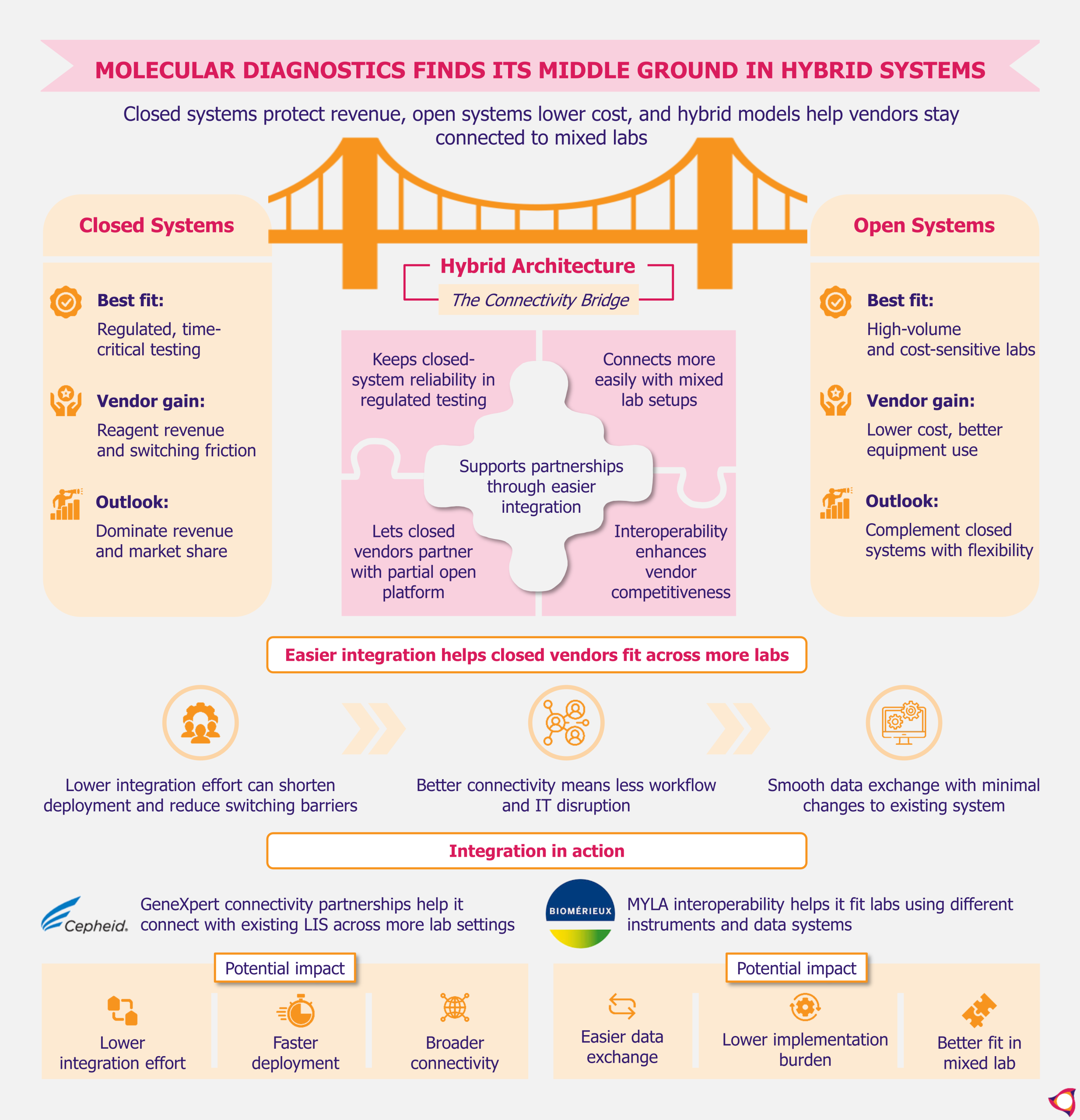
Molecular Diagnostics Finds Its Middle Ground in Hybrid Systems by EOS Implicium
Open systems remain essential for cost-sensitive labs
While closed systems are strong in central laboratories and decentralized or near-patient testing settings, open systems are needed across high-volume reference labs and emerging markets because of cost efficiency and flexibility.
OEMs position open systems particularly for emerging markets, where customers are highly price sensitive and prioritize lower per-test pricing. The assay and reagent flexibility of open molecular testing platforms allows laboratories to use lower-cost third-party assays, reagents, and consumables, which decreases overall testing cost.
Moreover, open architecture enables labs to preserve much of their existing infrastructure instead of replacing everything around one closed vendor. For example, Inpeco’s FlexLab is an open total laboratory automation (TLA) system that can connect a wide range of analyzers from different manufacturers. This allows laboratories to modernize operations while reducing disruption and equipment replacement.
In the near future, closed systems will likely continue to hold most of the value in terms of revenue and market share because of high-margin consumable models. Open systems will remain essential for cost-sensitive, high-volume environments. Rather than replacing closed systems, open architectures will complement them by enabling greater workflow flexibility, easier integration across mixed-vendor environments, and better utilization of existing laboratory infrastructure.
Hybrid architectures can help strengthen strategic partnerships
The gap between the open and closed systems is slowly narrowing. Labs are seeking standards-based interoperability to exchange test orders and results with LIS, middleware, EHR, and POC data-management systems. This has created an opportunity for semi-open or hybrid models, which are emerging as a strategy for traditionally closed-system vendors.
Laboratory middleware, POC data-management, and healthcare integration-engine vendors are unlikely to completely replace large IVD platform vendors, but they might become the connectivity layer that enables those vendors to offer greater flexibility.
For example, Cepheid and Oxford Nanopore developed a research-use-only workflow combining GeneXpert with nanopore sequencing in 2026. This may be an early signal that the company is testing how GeneXpert could connect to broader sequencing workflows. Guy’s and St Thomas’ NHS Foundation Trust’s role as a clinical research collaborator adds clinical credibility and visibility to this effort. If successful, analytical and clinical performance data from representative clinical specimens generated through the collaboration could support an FDA premarket submission and IVDR conformity assessment. It could also strengthen Cepheid’s position in future NHS framework call-offs, trust tenders, or integrated care system procurement decisions, although these remain prospective outcomes.
In the near term, hybrid architecture could become an important enabler of strategic partnerships in molecular diagnostics. This is especially true where integration complexity or data exchange has historically been a barrier. As labs prioritize interoperability and workflow flexibility, vendors offering more open integration may gain an edge in certain partnership decisions. That said, open architecture is only one factor in partnership decisions. Assay menu breadth, installed base, sequencing capabilities, etc., also play important roles.
Interoperability partnerships can support broader adoption
For IVD platform vendors, partnerships can expand instrument placements and assay utilization across more laboratory settings, while interoperability vendors gain visibility with larger diagnostic firms. However, these partnerships create value only when they reduce laboratory workload, accelerate deployment, or lower switching barriers.
Cepheid and bioMérieux are examples of IVD vendors that have added LIS, middleware, and healthcare interface capabilities to improve system connectivity and enable smoother integration with minimal workflow changes.
Open connectivity helps Cepheid reach more labs
Cepheid has built broad connectivity into GeneXpert by supporting interfaces with laboratory middleware and POC data-management vendors, including Data Innovations, Telcor, and RelayMed. This helps the platform connect with existing LIS, middleware, EMR, and POC data-management systems across many settings. These include hospital core labs, emergency departments, community clinics, urgent care centers, and resource-limited environments. Its modular, closed-cartridge, sample-to-answer design reduces analytical workflow and operator-training burden for many sites. However, the actual IT interface deployment complexity will depend on the IT infrastructure and institutional setup of the deployment site.
Cepheid’s partnership with Oxford Nanopore could be an early effort to maintain long-term relevance beyond PCR-based testing into next-generation sequencing (NGS) applications. While still in early stages, the partnership could evaluate whether GeneXpert placements can serve as the front end for future sequencing workflows. Also, it could help Cepheid preserve long-term customer relations as diagnostics shift towards sequencing and genomics insights.
Related reading:
Europe Respiratory PCR Market Favors Modular Panels Over Broad Tests
Interoperability expands bioMérieux integration opportunities
Labs often operate using different instruments, creating integration challenges due to various LIS platforms and connectivity requirements. To address these challenges, bioMérieux partnered with Corepoint Health to standardize and simplify interoperability and facilitate communication between its MYLA platform and different LIS. Better connectivity and integration capability make MYLA easier to connect, which improves bioMérieux’s chances of selling to laboratories with heterogeneous systems.
The 2019 merger between Corepoint and Rhapsody Health increased the strategic value of this partnership, making them one of the world’s most widely deployed healthcare interoperability platforms. This strengthened bioMérieux’s integration capability by supporting standards such as HL7 v2 messaging and FHIR-based APIs for exchanging laboratory orders, results, and other healthcare data between diagnostic systems, LISs, and EHRs.
FHIR compatibility reduces integration burden and positions bioMérieux to support data integration for clinical programs such as antimicrobial stewardship. Cleaner data exchange helps labs and hospitals to integrate microbiology results with wider clinical systems. In addition, it makes bioMérieux attractive to laboratories that prioritize FHIR compatibility as part of their long-term digital transformation strategies.
Explore more analysis on EOS Implicium
EOS Implic-Action: Vendors must make lab integration easier
The open-versus-closed system debate will likely remain an important factor in molecular diagnostics. However, future competition may increasingly depend on how effectively vendors combine the strengths of both approaches. Significant growth opportunities are shifting toward hybrid and connected architectures. This is where vendors can move beyond instrument placement, assay supply, and service contracts into co-development, connectivity, and workflow-integration roles.
Over the next 5-10 years, the industry could gradually shift toward connected instrument–assay ecosystems linked through laboratory middleware and integration engines. This is more likely especially in complex laboratory environments with multiple vendors and systems. In this setting, vendors that make their systems easier to connect and reduce integration effort for laboratories are likely to be better positioned. Maintaining compatibility within mixed lab setups will also be important for long-term competitiveness.