
Africa is currently facing significant challenges related to limited accessibility to vaccines as well as ongoing vaccine hesitancy. African CDC has identified these problems and is taking concrete steps to reach its 2040 target. By then, 60% of vaccines available on the continent should come from domestic production. India is one of the key countries investing in the growth of Africa’s healthcare sector, both financially and logistically. Africa and India have similar geographies, climates, disease prevalence, and economies. Because of this, Africa could learn from Indian vaccine manufacturers, collaborate with them, or replicate parts of their model to scale up its vaccine sector.
Africa’s vaccine gap shows up in low administration rates
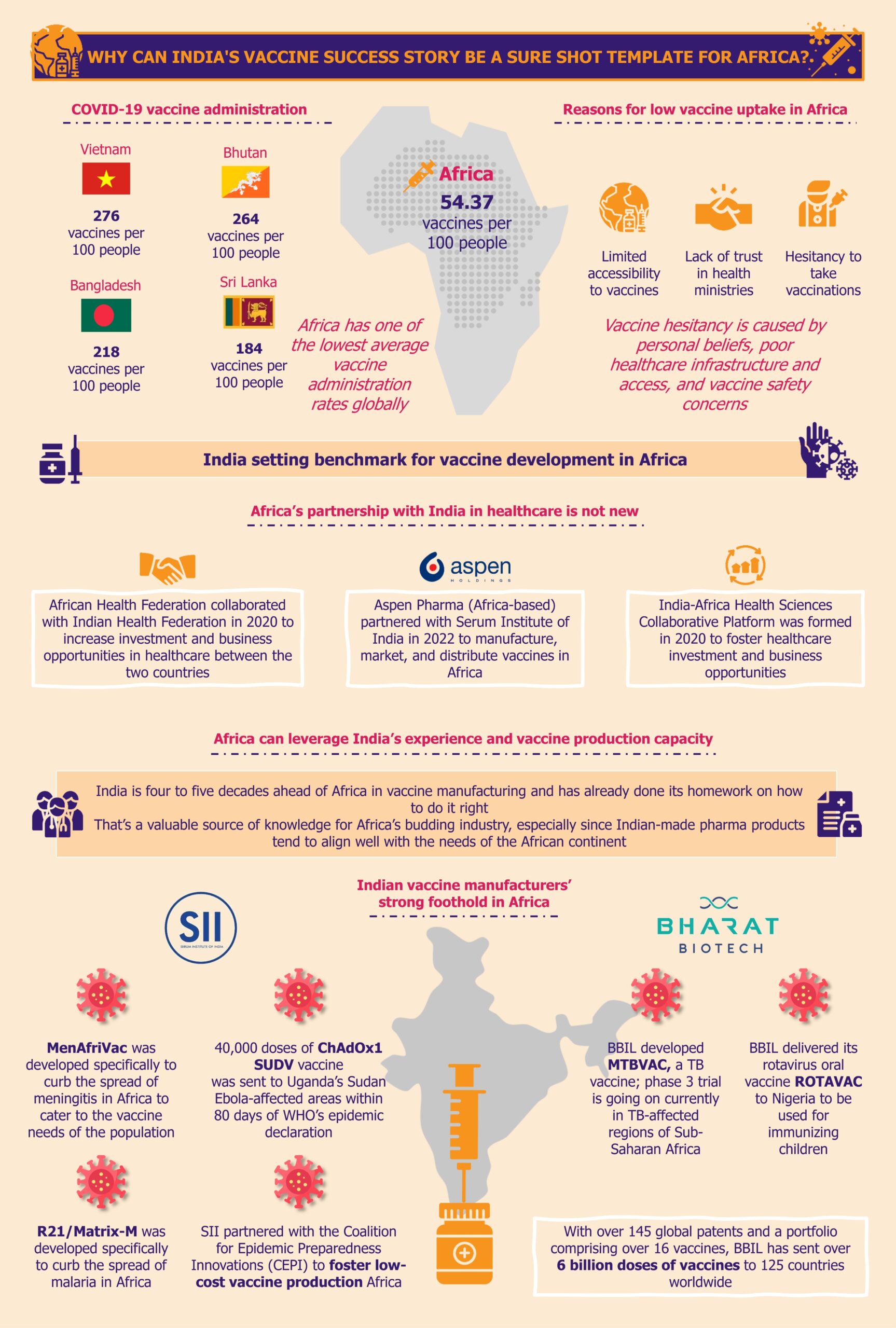
Unbalanced access to vaccines in Africa compared to other regions became quite vivid during the COVID-19 pandemic. Africa’s average number of coronavirus vaccine doses administered per 100 people was 54.37 as of March 15, 2023. Seychelles administered the highest number of vaccine doses at 205.37, and Burundi the lowest at 0.27.
In contrast, the world average stood at 173 doses per 100 people. High-income countries such as the USA and Canada administered 191 and 258 vaccine doses per 100 people, respectively. Interestingly, Cuba, despite being an upper-middle-income economy, administered 385, a higher number of doses per 100 people than some high-income countries.
Even some low-income economies administered more coronavirus vaccine doses than the world average of 173. These included Vietnam (276), Bhutan (264), Bangladesh (218), Nepal (213), and Sri Lanka (184), among others. Their numbers were also far above Africa’s average.
These stark variations in the vaccine administration rates across countries are due to the lack of easy accessibility, especially in Africa, apart from other factors such as vaccine hesitancy.
Vaccine hesitancy slows Africa’s already weak uptake
Several factors cause vaccine hesitancy. These include personal beliefs, misinformation or myths, healthcare infrastructure and access, religious and cultural beliefs, and vaccine safety concerns, all likely to apply to the African continent.
Another critical factor is people’s lack of trust in health ministries. This is relevant in some African countries, such as South Africa. This was largely due to the ministries’ involvement in procurement corruption of COVID-related aid, according to an article published by GlobalData in November 2023.
Limited vaccine access keeps Africa’s administration rates low
One major reason for the vaccine’s low administration rate in Africa is the limited accessibility to vaccines. This has been an ongoing issue on the continent, and not just around pandemics such as COVID-19 and Ebola.
The African continent is overdependent on vaccine imports, with 99% of its vaccine needs being satisfied from abroad. Africa has 13 operational vaccine production facilities across the continent. Its vaccine manufacturing industry is still in its infancy and produces 1% of the continent’s vaccine supplies.
African countries have recognized this issue and begun working towards their goal of meeting 60% of the continent’s vaccine needs domestically by 2040. The interim targets are 10% by 2025 and 30% by 2030.
Africa’s vaccine talent lacks a tested production playbook
The local vaccine industry is underdeveloped, to say the least. Still, the continent is not entirely without the talent required to produce home-grown vaccines and other pharmaceutical products such as test kits. For instance, the Senegal-based Pasteur Institute developed a US$1 finger-prick at-home antigen test for COVID-19 in partnership with Mologic, a UK-based biotech company. Although the funding came partially from the UK, local talent was predominantly utilized.
To establish a sustainable vaccine sector, Africa does not need to reinvent the wheel. It could utilize lessons and success stories of other countries that have built this industry and share similarities with the African continent.
India is one such country, with vast size, diverse cultures, varied geography, and complex administrative structures under one roof. It also has a tropical climate and disease profile similar to those in Africa. India’s close healthcare relationship with Africa would also help. It could make it easier for Africa to use the expertise of the Indian vaccine sector. This could be a step in the right direction for the African continent to achieve vaccine sovereignty.
Africa’s Vaccine Import Gap Gives Indian Producers a Clear Role by EOS Implicium
India’s healthcare ties give Africa a familiar vaccine partner
Africa has a long-standing healthcare partnership with India, as the latter has been the largest supplier of generic medicines to Africa. Additionally, some US$3.4 billion worth of pharma products went to African countries as of 2018. This was close to 20% of India’s total pharma exports. In 2020-2021, India’s pharma exports to Africa amounted to US$4.3 billion as per the Pharmaceuticals Export Promotion Council of India (Pharmexcil).
Between 2010 and 2019, India was also the third-largest contributor to Africa’s healthcare investment landscape, after the UK and the USA. During this period, India invested around US$210 million in Africa’s healthcare sector. This came out of US$1.1 billion in total global investment and gave India a 19% share.
In the past, African pharma companies have relied on Indian organizations to pivot and streamline their business in difficult times. For instance, South Africa-based Aspen Pharmacare could not sell a single dose of its COVID-19 vector vaccine owing to multiple factors, such as the rising popularity of mRNA vaccines. Ultimately, the company partnered with the Serum Institute of India (SII) in August 2022 to produce its vaccines. The move aimed to reduce business losses and idle production capacity. This is just one example showcasing opportunities where African vaccine producers collaborated with Indian vaccine makers. This kind of collaboration can also become a source of guidance. It can show African producers how to create their own sustainable vaccine production ecosystem.
Collaborations between Africa and India have also extended beyond adverse situations. One example of this is a partnered research to produce a DNA-based dengue vaccine. Scientists from India, Nairobi, and Cameroon have been working together. Their partnership is called the India-Africa Health Sciences Collaborative Platform (IAHSP), set up in 2019. The partnership results from a collaboration between India’s ICMR (Indian Council of Medical Research) and the African Union. It aims to create this DNA-based dengue vaccine, among other research work involving antimicrobial resistance. This is according to a January 2022 Springer Nature article.
Furthermore, in December 2020, the Indian Healthcare Federation (NATHEALTH) and the African Health Federation (AHF) partnered to foster investment in healthcare and thus promote business opportunities in healthcare between India and Africa.
India’s vaccine scale offers Africa lessons in low-cost supply
The Indian vaccine production sector is rapidly gaining steam in the global market and outpacing multinational players in this industry. A few prominent Indian vaccine producers, such as SII, Bharat Biotech (BBIL), and Biological E, have captured a considerable market share globally.
Interestingly, only five producers globally satisfy over 60% of the global vaccine needs in terms of volume. Three of these five producers are in India: Pune-based SII, Hyderabad-based BBIL, and Mumbai-based Haffkine. SII tops the list of these five global producers with a 28% volume share globally, and BBIL (9%) shares the third spot with Sanofi, followed by Haffkine (7%), as of 2019.
For many years, India has been supplying cost-effective and high-quality generic medicines and vaccines, which has earned the country the title of ‘pharmacy to the world’. As of 2023, India alone accounted for 62% of global vaccine production and 20% of global generic drug production by volume. The Indian pharma sector holds the third rank by production volume and tenth by value globally.
With an 18% share of pharmaceutical exports and vast needs, Africa is the second-largest importer of pharmaceutical products from India as of 2019.
Indian vaccines show how low-cost shots can fit African needs
In its quest to develop its own vaccine production sector, Africa can learn a host of aspects of vaccine production from India. This includes the cost-effectiveness of vaccines against diseases such as COVID-19, rabies, diphtheria, pertussis, tetanus (DPT), human papillomavirus (HPV), malaria, Ebola, and meningitis. India is four to five decades ahead of Africa in vaccine manufacturing and has already done its homework on how to do it right. That is a useful source of knowledge for Africa’s budding industry. Indian-made pharma products also tend to align well with the needs of the African continent.
Serum Institute shows how India-made vaccines can cut Africa’s disease burden
SII is now the largest vaccine producer by the number of doses manufactured and sold worldwide. In 2020, it sold over 1.6 billion doses across 170 countries. These included vaccines for polio, diphtheria, tetanus, pertussis, Haemophilus influenzae type b (Hib), BCG, r-Hepatitis B, measles, mumps, rubella, pneumococcal disease, and COVID-19. Nearly 65% of children across the globe receive at least one vaccine produced by SII.
SII has a strong foothold in Africa, with several of its vaccine products being extensively used or developed specifically for the continent’s needs.
MenAfriVac, manufactured by SII, is a vaccine to prevent meningitis and was rolled out in Africa in 2010. The vaccine aims specifically to curb the spread of meningitis in Africa to cater to the vaccine needs of its population. The price of the vaccine is less than US$0.50 per dose. Its efficacy is 52% among 12–23-month-old children and 70% among older children and adults. Thanks to the vaccine, over 152 million people were inoculated with MenAfriVac by the end of 2013. This enabled the elimination of meningitis epidemics in 26 African countries.
Another example of an India-made vaccine to particularly reduce Africa’s disease burden of malaria and cater to its people’s vaccine needs is R21/Matrix-M. SII, along with Oxford University, has produced this malaria vaccine using the technology of Novavax, a US-based biotech company. As of December 2023, some African countries’ regulatory authorities approved the vaccine. These included Ghana, Nigeria, and Burkina Faso. As per SII, the vaccine showed efficacy of around 78% over the first year. This was among children aged five to seventeen months in Burkina Faso, Kenya, Mali, and Tanzania. The company is planning to roll out the 25 million vaccines produced in the coming four to five months.
In December 2022, SII acted rapidly on the Sudan Ebolavirus outbreak in Uganda by sending over 40,000 doses of the investigational ChAdOx1 SUDV vaccine in a record time of 80 days after the WHO declared the epidemic.
These are some examples showcasing the fact that SII, along with other Indian producers, understands Africa’s vaccine needs, which is evident from the success of these vaccines in Africa. Consequently, it makes logical and economic sense for Africa to learn from Indian vaccine manufacturers to develop low-cost, effective vaccines.
Apart from successfully selling its vaccines in Africa, SII also actively contributes to the knowledge transfer into the continent. In January 2024, SII partnered with the Coalition for Epidemic Preparedness Innovations (CEPI). The partnership aims to foster low-cost vaccine production in Global South countries, including Africa. It also covers Latin America and the Caribbean, Asia excluding Israel, Japan, and South Korea, and Oceania excluding Australia and New Zealand. The goal is to curb outbreaks of life-threatening diseases. CEPI is a global organization formed through international collaboration. It brings together public, private, philanthropic, and NGO partners.
CEPI has three other members apart from SII: South Africa-based Aspen Pharmacare, Senegal-based Institut Pasteur de Dakar, and Indonesia-based Bio Farma. With this partnership, CEPI intends to capitalize on SII’s expertise in making affordable, cost-effective vaccines in record time. In this pursuit, CEPI is investing US$30 million. The funding should help vaccine developers who already partner with CEPI expedite technology transfers to SII within days or weeks of any outbreak. This will enable SII to produce vaccines against the impending disease.
Bharat Biotech adds disease-matched vaccines to Africa’s supply base
With over 145 global patents and a portfolio comprising over 16 vaccines, BBIL has sent over 6 billion doses of vaccines to 125 countries worldwide. BBIL has produced vaccines against influenza H1N1, rotavirus, Japanese encephalitis (JENVAC), rabies, chikungunya, Zika virus, and cholera. The company is also the creator of the world’s first tetanus toxoid conjugated vaccine for typhoid. BBIL has also manufactured WHO-prequalified vaccines. These include BIOPOLIO, ROTAVAC, ROTAVAC 5D, and Typbar TCV against polio, rotavirus, and typhoid infections, respectively.
BBIL has also been offering its products to Africa. In one recent example, the company delivered its rotavirus oral vaccine, ROTAVAC, to Nigeria. The delivery took place in August 2022 to immunize the country’s children. The vaccine will likely minimize the occurrence of the disease and death due to rotavirus among Nigerian children below the age of five years by at least 40%, according to research by the Johns Hopkins Bloomberg School of Public Health.
More in this Africa vaccine series:
India’s Lessons for Africa’s Vaccine Manufacturing Start With Skills
Africa’s Vaccine Push: Local Shots Need More Than Imported Cash
Another example of a vaccine by BBIL for the needs of the African population is MTBVAC. In March 2022, the company announced its partnership with Spain-based biopharmaceutical company Biofabri. The partners planned to develop, produce, and distribute MTBVAC, a novel TB vaccine. The Phase 3 trial is currently underway in TB-affected regions of Sub-Saharan Africa, such as South Africa, Madagascar, and Senegal. Sub-Saharan Africa and India each account for 25% of the global TB burden. The vaccine is being developed to target TB in these susceptible regions to eradicate the disease.
Several other Indian manufacturers have rolled out successful vaccines against various diseases in Africa that have significantly reduced the disease burden in the region.
EOS Implic-Action: Africa’s vaccine push needs India-style know-how
Achieving 60% local vaccine production within 15 years will be possible only if Africa chooses a robust role model to learn from. India stands out as possibly the only near-perfect choice for that. To build a sustainable vaccine ecosystem, Africa should work closely with Indian manufacturers. It should learn from them, collaborate with them, and replicate parts of their model where suitable.
Explore more analysis on EOS Implicium
The world has evolved, and many steps that India took in the past cannot be directly transplanted into the current African scenario. However, India’s approach to building self-reliance in pharmaceutical production can undoubtedly offer valuable lessons. Africa could use India’s vaccine-making expertise across several critical areas. These include direct know-how and technology transfer, collaboration, talent training, production facility management, procurement handling, supply chain management, licensing, and IP protection.
By choosing India as a role model, Africa could learn from its focus on building a competitive pharma manufacturing industry. This could help Africa move closer to self-sufficient vaccine production.