
For electrospun wound care companies, the first product format shapes more than the initial launch. A preformed wound matrix can make later extensions easier when some material, testing, and workflow requirements carry over. An in-situ system can cover uses where sheets are less practical, although it also brings a device and additional usability requirements. That affects the cost of later expansion, the adoption burden, and how much earlier development work can be reused as the portfolio grows.
Preformed matrices and in-situ systems fit wound care in different ways
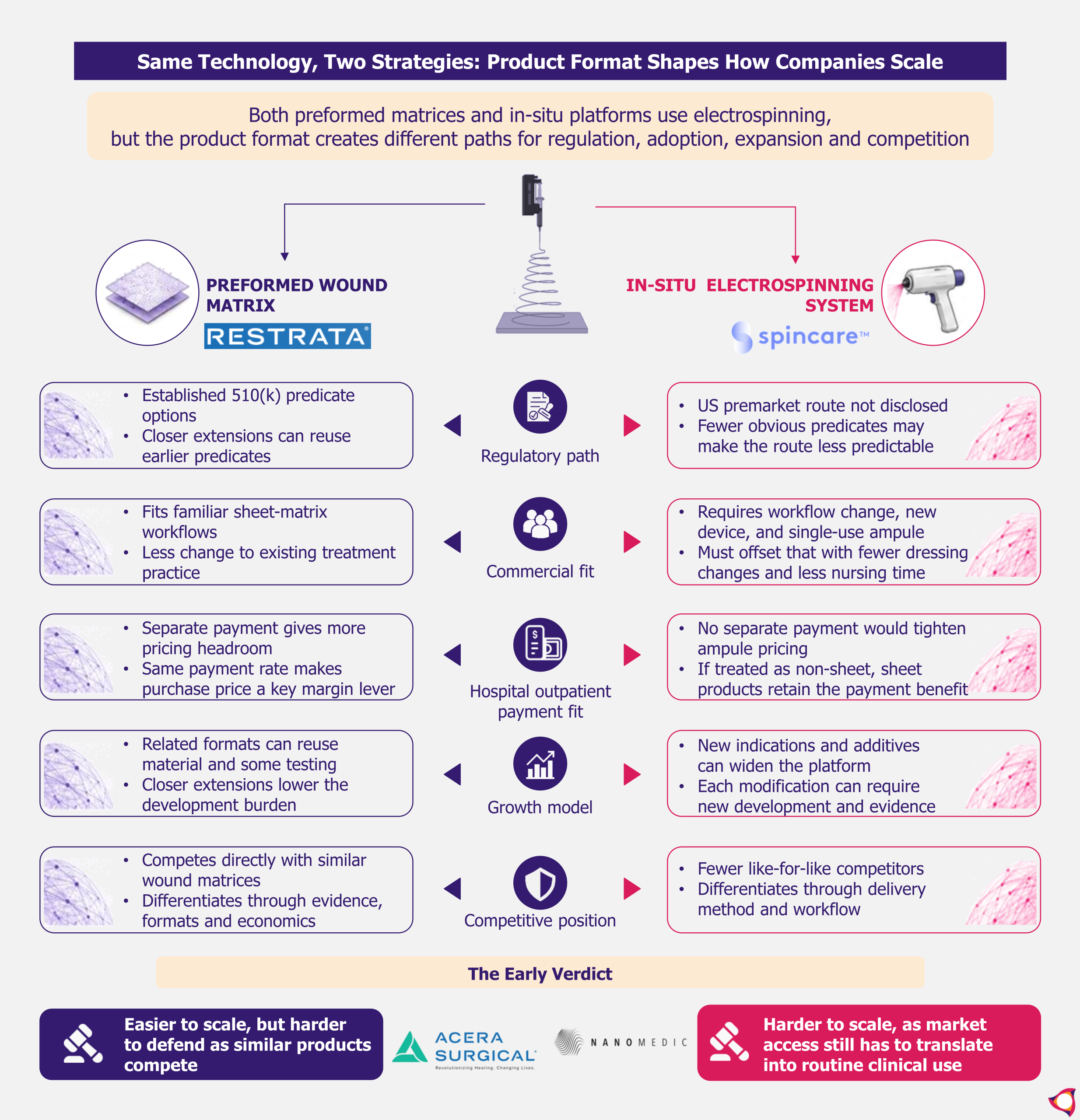
Nanomedic and Acera Surgical show how differences in product format can lead companies down very different commercial paths. Acera Surgical entered the electrospun wound care market with Restrata, a standardized preformed electrospun wound matrix. It fits within an established wound dressing format. On the other hand, Nanomedic’s Spincare is an in-situ electrospinning system, which spins the nanofibrous matrix directly on the wound. While both use the same underlying technology, they apply electrospinning in different formats that may offer advantages in different situations.
Restrata’s preformed format places it within a treatment workflow already used with other sheet-applied wound matrices and tissue products. Its indications span chronic ulcers, tunneled wounds, surgical wounds, and traumatic wounds. Products such as Integra Bilayer Matrix Wound Dressing and MiMedx EpiFix use different biomaterials and are not like-for-like products, but they can compete for some of the same treatment decisions. Restrata therefore enters an established application format, where differentiation has to come from factors beyond the fact that the product is sheet-applied.
Related reading:
CAMPs Scale-Up Turns Wound Care into a Test of Evidence and Reach
Spincare’s in-situ format creates a different basis for differentiation. Nanomedic states that the matrix conforms directly to wound shape and contours without fixation, which can be useful in hard-to-dress areas. Its indicated uses still overlap with established wound care options, covering non-infected superficial and partial-thickness acute or chronic wounds. Spincare therefore does not depend on serving a wholly separate wound category. Its format can differentiate the product where preformed sheets are less practical, while also introducing a device-based treatment workflow.
Electrospun Wound Care Growth Takes Shape Around Product Format by EOS Implicium
In-situ electrospinning adds workflow demands but can reduce follow-up care
The adoption difference goes beyond the application method. Spincare adds a handheld device and single-use ampules, but it can also change resource use across the treatment episode. The matrix can remain in place during healing and allow wound assessment without removal. That can reduce repeat dressing changes, nursing time, and dressing use. Its portable, battery-operated format may also support use across more care settings rather than only specialist centers.
For hospitals and wound care services, part of the adoption decision is whether fewer dressing changes and less nursing time offset the extra device step and ampule cost.
A preformed matrix stays closer to established dressing workflows. Spincare has to show that lower follow-up resource use and use across more care settings justify changing the treatment workflow.
Product format shapes how electrospun wound care companies expand
The first product format also shapes the direction of later portfolio expansion. Acera has already extended Restrata in two ways. Restrata Meshed and MiniMatrix changed the product configuration while retaining wound management use, while Restrata Soft Tissue Reinforcement carried the same core material into a different intended use for soft-tissue reinforcement. The portfolio has therefore expanded from format extensions within wound care into an adjacent surgical use.
Nanomedic’s route is still prospective. The company describes Spincare’s electrospun matrix as a platform for drug delivery and says future versions may incorporate antibacterial agents, collagen, adhesives, or embedded human cells for more severe wounds. That points to expansion through changes in what the in-situ matrix contains or delivers, rather than through additional matrix configurations. At this stage, however, Nanomedic has not yet built a product expansion record comparable with Restrata’s.
Predicate options change as electrospun wound care products expand
Restrata’s regulatory history shows how predicate selection can change as the portfolio expands. Acera received FDA clearance in 2017 for its Restrata Wound Matrix via the 510(k) pathway. Later Restrata products were also cleared through the 510(k) pathway, but the predicate approach changed when the portfolio moved further from the original wound matrix use. Restrata Meshed and MiniMatrix used earlier Restrata products as predicates, while Soft Tissue Reinforcement used Kerecis Reconstruct, with earlier Restrata and Cerafix devices as reference devices.
Spincare has carried the CE mark since 2019 and began commercial sales in Europe in 2020. It has not yet secured FDA marketing authorization, and Nanomedic has not publicly disclosed the US premarket route. Spincare’s in-situ electrospinning system appears less straightforward to compare with an established wound matrix predicate. This may make the US regulatory pathway less predictable than for closer extensions of an established wound matrix product.
Product format changes how electrospun wound care products compete
Restrata’s preformed format places it in direct competition with other electrospun wound care matrices, such as Phoenix Wound Matrix, cleared to Nanofiber Solutions in 2018 and marketed by RenovoDerm. Both are fully resorbable synthetic matrices. Their FDA indications for use are nearly identical, covering diabetic, venous, pressure, and chronic vascular ulcers, tunneled and undermined wounds, surgical, trauma, and draining wounds. Both cited GORE BIO-A as a predicate in their 510(k) submissions: Restrata in its initial clearance in 2017 and Phoenix in 2018. FDA later recategorized both under the same product code, QSZ, absorbable synthetic wound dressing.
With nearly identical indications and the same FDA product code, clearance offers little separation between Restrata and Phoenix. Acera differentiates Restrata through clinical evidence and available formats, with 38 peer-reviewed publications and MiniMatrix adding a dispersible format. For comparable matrices, clinical evidence and additional formats can therefore carry more weight in product choice.
Spincare’s in-situ format gives it a clearer point of differentiation where sheet-form products are less practical, including hard-to-dress areas. Where sheet application is not a problem, however, the format itself may carry less weight. Nanomedic therefore has to show enough clinical or operational benefit for clinicians to choose Spincare over established wound care options.
Medicare hospital outpatient payment differs by product format
Medicare’s 2026 hospital outpatient policy pays separately for covered sheet-form skin substitute products, while non-sheet products remain packaged into the procedure payment. Restrata and Phoenix both receive the same national product payment of US$127 per cm² in this setting. At the same hospital, both products bring the same payment rate, but their purchase prices can still affect the margin on each application.
MiniMatrix is dispersible rather than sheet form, so its payment remains packaged. A format extension can therefore add clinical flexibility without qualifying for separate payment. Acera still has a separately paid sheet product alongside MiniMatrix. A company selling only a non-sheet product would have no separately paid product at all.
Spincare’s US coding and payment route is still unknown. If Medicare classifies its in-situ matrix as non-sheet under the current policy, the hospital would receive no separate product payment. That would raise the adoption hurdle in hospital outpatient care. The product would need to fit within the existing procedure payment and put more pressure on purchase price.
EOS Implic-Action: Product format changes the work needed to scale
Acera’s case shows that reusing the technical base is only part of the expansion economics. Solventum completed its acquisition in December 2025 for US$725 million upfront, about eight times Acera’s expected 2025 sales, plus up to US$125 million in milestones. Solventum highlighted Acera’s commercial footprint and fit with its specialized wound care sales force and existing acute care business. A larger partner can make related matrix products easier to scale when it already serves many of the same wound care accounts.
That fit has already started to extend beyond sales reach. In October 2026, the FDA cleared the combined use of Restrata Matrix with Solventum’s V.A.C. Therapy. This gives Solventum a way to connect Restrata with an established negative pressure wound therapy platform and the wound care accounts it already serves. That can make Restrata easier to expand within existing customer relationships than it would have been for Acera as a standalone company.
Explore more analysis on EOS Implicium
Spincare’s device-based format also changes the work involved in entering a market. In India, Nanomedic works with Fischer Medical Ventures, which holds exclusive distribution rights for Spincare in India and Southeast Asia. Before Spincare received CDSCO approval for commercial import and distribution in July 2026, Fischer worked with Indian hospitals on evaluations, demonstrations, and training under a test license. In the UK, Nanomedic similarly paired market registration with a hospital collaboration to establish its presence.
This makes local market development part of scaling, rather than distribution alone. For Nanomedic, commercial partners may need to help establish hospital use of the system as well as secure market access. If other markets require similar work, adding countries will not by itself show how far Spincare has scaled. Market access still has to translate into routine clinical use.