Globally, aquaculture farms face pressure to expand production. At the same time, they must deal with climate risks, stricter environmental standards, and high mortality rates. This is pushing farms to adopt digital tools for better farm visibility and support operations. While early solutions focused on sensors and hardware, providers now compete by building intelligent, automated farm systems. But success requires more than technology. Providers win when they prove measurable value. This includes lower feed costs, fewer losses, more predictable harvests, or faster payback.
Advanced sensing wins when it improves farm decisions
Basic sensors that monitor temperature, pH, and oxygen levels are becoming standard. While these tools improve monitoring, they do not directly help farmers make day-to-day decisions. Farmers still need to know when and how much to feed, and when to harvest.
Competition is now shifting toward advanced sensing technologies to understand fish behavior and growth patterns in greater detail. However, the value is not in data alone. The real advantage comes when companies turn this data into better decisions.
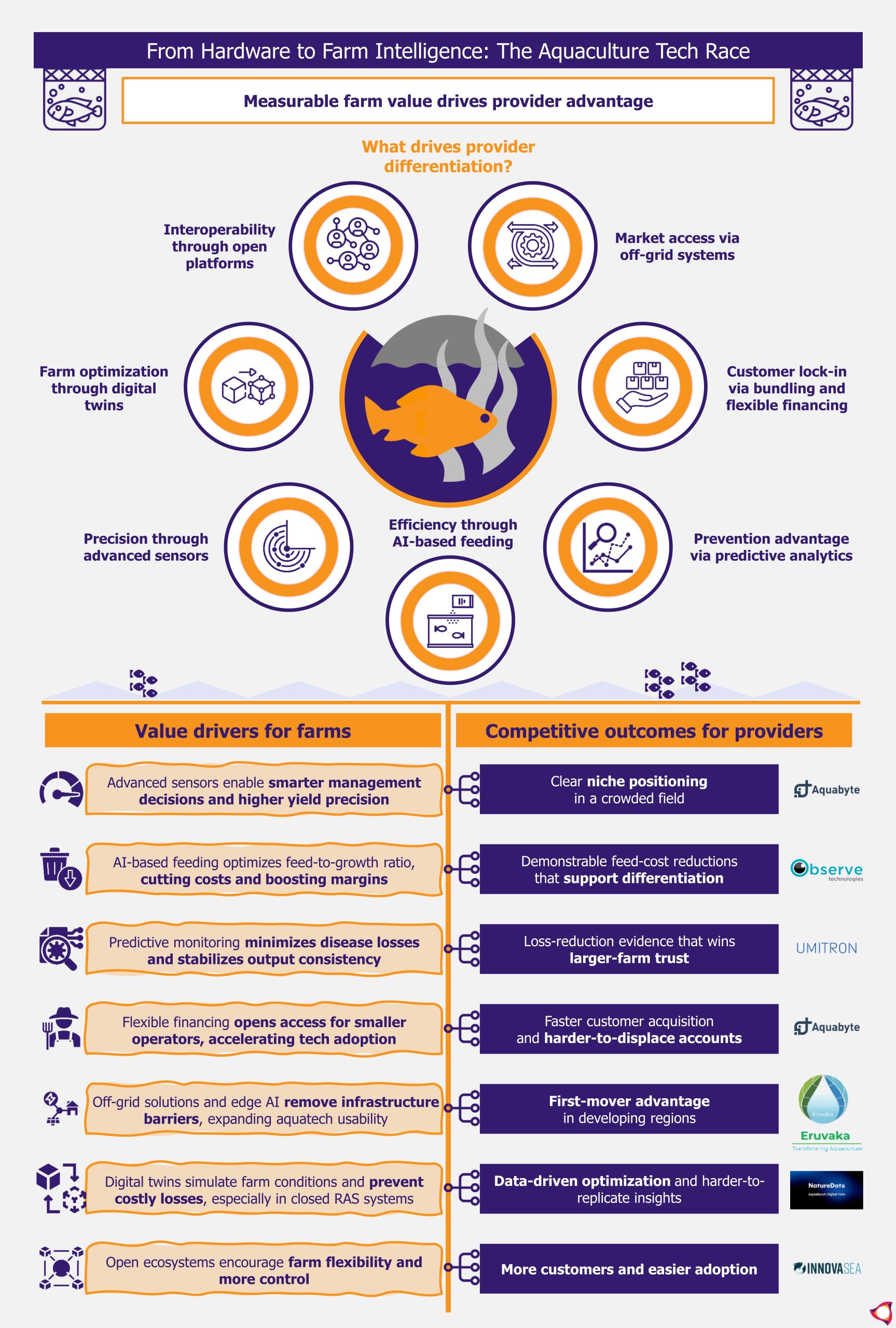
Farms will adopt these tools only if they improve farm performance. They must reduce feed waste, improve feed conversion, lower mortality, estimate fish weight more accurately, or help determine the right harvest time. Aquabyte illustrates this by combining computer vision, AI, and data analytics to help farms improve biomass estimation and feeding optimization. Rather than simply collecting data, the company aims to provide information that farmers can use to adjust feeding, monitor fish growth, and plan production.
As basic sensors become widely available, the hardware itself becomes less of a differentiator. Vendors that rely mainly on monitoring features may find it harder to justify higher prices.
AI Will Separate Aquaculture Tech Leaders from Hardware Vendors by EOS Implicium
AI helps providers win through better farm economics
AI is becoming a key differentiator as farms look for systems that can turn data into actions.
Predictive AI helps farms anticipate potential risks and improve decisions around feed optimization, biomass estimation, and disease management. Reducing unnecessary feeding directly improves margins by lowering feed costs. Biological losses reduce the fish available for sale, so lower mortality protects revenue. More accurate biomass and harvest planning help farms avoid selling too early, too late, or at the wrong weight.
Better predictions alone do not guarantee better outcomes. Farmers must trust these systems and incorporate them into daily decisions. This is challenging because farmers have traditionally relied on experience and visual assessments to manage farms.
That said, providers with AI capabilities will likely move beyond selling equipment to delivering solutions that improve farm economics. Larger aquaculture platform providers may acquire specialist AI firms instead of developing every capability in-house. AKVA Group’s acquisition of UK-based Observe Technologies in 2024 illustrates this. Rather than building its own AI feeding technology from scratch, AKVA deepened an existing partnership by acquiring Observe, bringing an already proven commercial solution fully into its product portfolio. For equipment providers, owning AI tools can make their systems harder to compare on hardware specs alone.
As environmental risks become more frequent, vendors can also strengthen differentiation by combining weather data with farm records, site histories, and production outcomes. This allows farms to prepare for events such as algal blooms, low oxygen, or extreme weather changes. As more data becomes available, providers can improve AI models that are harder for competitors to replicate.
Related reading:
Pet Health M&A Heats Up as Players Chase Scale, Scope, and New Markets
Digital twins must prove value before farms adopt them
As land-based RAS systems expand, demand for digital twins is increasing. RAS farms are expensive to build and operate, with fish kept in tightly controlled systems. If oxygen, water quality, feeding, or equipment systems fail, farms can suffer significant biological losses quickly.
Digital twins allow farms to test different operating scenarios, reducing operational risk in land-based systems. For instance, farms can simulate changes to feeding schedules or harvest timing and assess their impact before any operational changes.
However, commercial adoption of digital twins remains limited. Most deployments are confined to advanced pilots, large-scale RAS facilities, and academic research. The value of digital twins depends heavily on the quality of the data and models behind them. If the inputs are unreliable, simulations may look advanced but provide limited practical value. Data silos, complexity in biological modeling, and high costs are other barriers to adoption.
Though companies are actively developing many digital twin solutions, widespread adoption will depend on whether they can deliver clear benefits for farmers. These benefits must justify the investment.
Flexible business models will expand aquaculture tech adoption
Flexible pricing helps smaller farms adopt aquaculture tech
Costs remain one of the main barriers to tech adoption in small farms. These farms make up a large share of producers, especially in Asia, but they are often less able to absorb high upfront costs. They are more likely to adopt when flexible pricing or financing lowers the barrier to entry. Vendors tailoring prices to small farms are better positioned to capture this high-potential segment, which is unlikely to accept high upfront fees.
Aquabyte shows this approach through its tiered SaaS-based subscription model for AI-based monitoring systems. The company lowers upfront investment by subsidizing the initial hardware costs. Instead, it charges recurring subscription fees based on the specific services a farm needs.
However, affordability alone may not solve the adoption challenge. Many small farms still hesitate because of limited digital infrastructure, technical expertise, and uncertainty about outcomes. These farms need tools that are simple to use and easy to support.
Generative AI may lower adoption barriers by making digital tools easier to use. Instead of analyzing multiple dashboards, AI-driven interfaces could turn complex farm data into information much easier for farmers to understand. This can lower training effort, drive easier daily use, and simplify decision-making for farmers.
While tiered pricing attracts small farms, bundling solutions can retain larger farms. Integrated platforms raise switching costs, making providers harder to replace than single-feature rivals. However, bundling limits flexibility and creates farmers’ concerns around vendor lock-in.
Locally adapted solutions win in emerging aquaculture markets
Unreliable power and poor connectivity are other hurdles in emerging markets. In these regions, buyers value affordable and reliable solutions more than advanced features. Companies such as Eruvaka, based in India, focus on this market segment, providing solar-powered systems and low-cost LoRaWAN data transfer solutions. That makes it harder for vendors built around premium, feature-rich systems to compete in these markets. Vendors that adapt their offerings to local constraints may attract government or donor support.
Speed is another important competitive factor. Providers that can process data closer to the farm through edge AI may have an advantage, as remote regions tend to have poor connectivity. While cloud solutions offer better analytics and long-term insights, combining cloud and edge capabilities can create more practical solutions for these conditions.
Platforms designed to handle real conditions can win in these markets. Simply replicating high-end solutions brings a risk of exclusion from the fastest-growing aquaculture regions.
Open aquaculture platforms will become easier to sell
As farms become more complex, farmers will prefer solutions that integrate with existing infrastructure. Closed ecosystems may give stronger customer lock-in. However, they can limit farm flexibility by preventing different devices from working together. Providers will have to offer open APIs and plug-and-play systems to allow farmers to upgrade without replacing entire systems.
However, openness also increases vendor burden. More integrations increase support demands, security risks, and operational complexity. The challenge is to balance flexibility with security and reliability. Firms that rely solely on closed hardware ecosystems may struggle as farms increasingly demand connected and flexible solutions.
EOS Implic-Action: Farm data will favor connected platforms
Aquaculture technology is likely to become more connected over time. Instead of separate systems, farms will operate as integrated platforms that combine hardware, sensors, AI, and other farm management tools. Together, this could move farms toward more autonomous management by reducing manual intervention and improving farm efficiency. This shift is likely to favor providers offering interoperable and scalable platforms rather than standalone products.
Farms will increasingly expect integrated platforms to combine production, feeding, health, and environmental data for traceability and compliance. This is especially true for large commercial farms, where data-driven operations are becoming standard. This will likely shift competition from standalone traceability tools toward embedding compliance, reporting, and audit functionality into farm systems.
Explore more analysis on EOS Implicium
Meanwhile, tech growth will not happen at the same pace everywhere. Large commercial farms are likely to move faster because they have greater resources and stronger infrastructure. Smaller farms may follow a slower path. They may prioritize affordable solutions that address immediate farm challenges.
Providers will have to sell differently in each market. Still, farms are more likely to adopt systems that turn farm data into decisions they can repeat, afford, and rely on in daily work.