
Aquaculture farms are gradually adopting preventative health solutions to reduce dependence on antibiotics and improve fish health. As a result, vaccines and functional feed solutions are receiving greater attention. While digital tools support earlier detection and farm decision-making, these solutions strengthen biological resilience over the course of the production cycle. Beyond biological performance, aquaculture vaccine and feed companies need manufacturing scale, regulatory expertise, and cost-effective solutions. These capabilities will determine which firms gain market share.
Advanced aquaculture vaccines shift competition toward scale and delivery
Conventional inactivated and live-attenuated vaccines remain commercially important in aquaculture and have long protected against various fish diseases, particularly bacterial diseases. But limitations in addressing emerging pathogens and delivering vaccines at large scale are creating opportunities for newer platforms. The industry is therefore increasingly investing in advanced aquaculture vaccines.
Subunit and recombinant vaccines can provide greater specificity and production flexibility. DNA vaccines can offer stability and potentially long-lasting immunity. RNA vaccines can enable rapid vaccine design and adaptation to emerging pathogens. While each of these vaccines offers different advantages, they also face different commercial challenges.
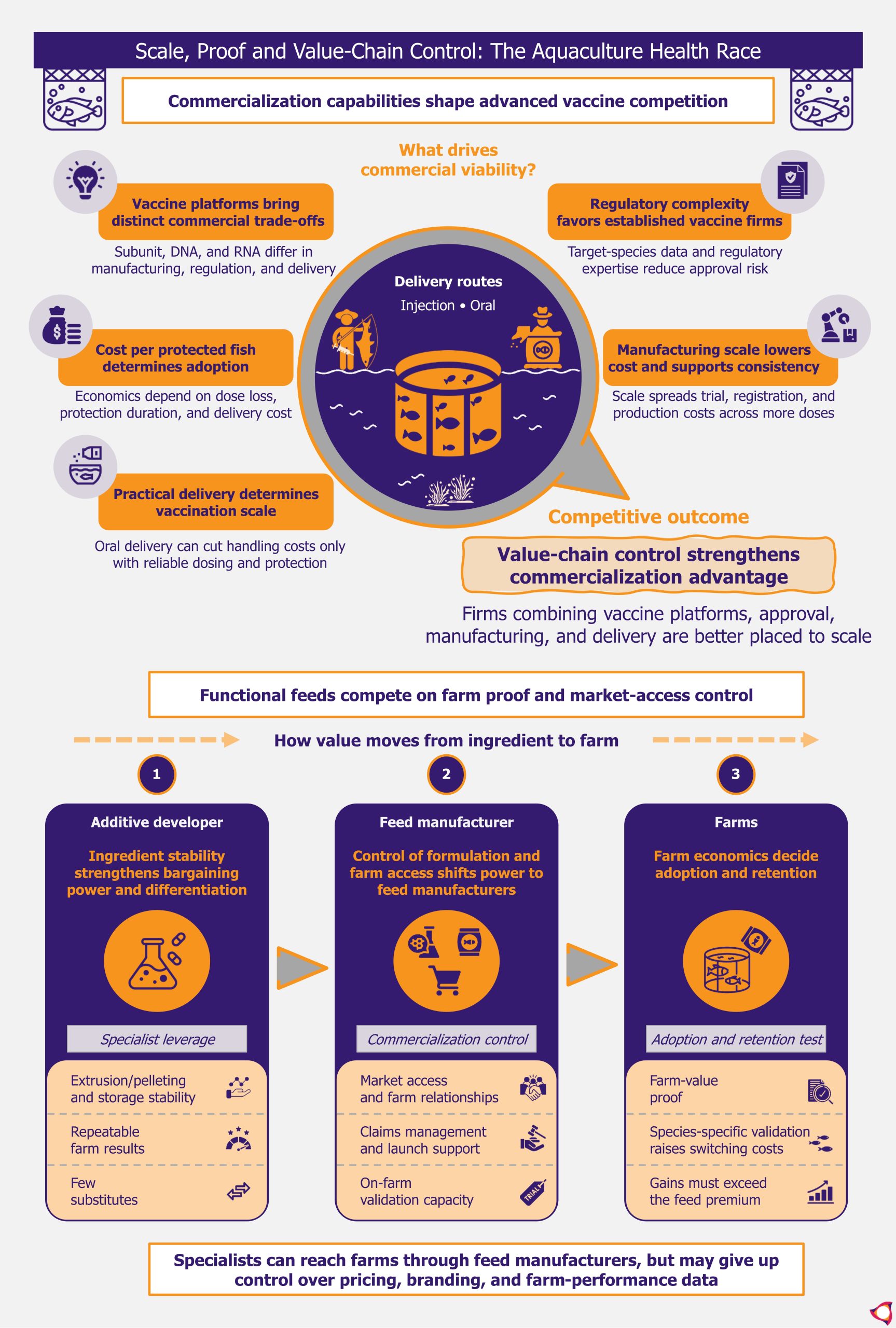
Aquaculture Health Winners Pair Scale with Smarter Delivery Economics by EOS Implicium
Subunit aquaculture vaccines compete on manufacturing cost and consistency
For subunit vaccines, including recombinant vaccines, the challenge lies in scaling production. Companies must also maintain consistent quality at commercially viable costs. Since purified antigens may have lower immunogenicity, they often need specialized adjuvants or other formulation support, which can increase manufacturing costs. As a result, manufacturing scale and formulation expertise become important success factors.
DNA vaccine regulation favors established aquaculture firms
Plasmid DNA vaccines undergo strict regulatory evaluation. Regulators assess how long vaccine DNA remains in the fish, where it distributes in the body, whether it integrates into the genome, and any potential environmental effects. For example, Canada’s Centre for Veterinary Biologics classifies plasmid DNA vaccines as biotechnology-derived veterinary biologics. It evaluates these products case by case. This adds regulatory complexity and increases time-to-market.
The complexity of approval tends to favor established vaccine firms. Their advantage comes from years of experience testing vaccines in target species, strong regulatory knowledge, and established safety data. They also benefit from reliable manufacturing processes, quality control systems, and the ability to support vaccine delivery at the farm level. These capabilities help reduce dossier gaps, the need for repeated testing, and approval risks. Companies can also spread trial, registration, and manufacturing costs across more doses and markets.
An authorized vaccine and its supporting regulatory dossier can remain valuable even after ownership changes. Elanco’s Clynav DNA vaccine against Salmon Pancreas Disease (SPD) demonstrates this. The product was included in Merck Animal Health’s acquisition of Elanco’s aqua business, showing the value of established vaccine assets.
Related reading:
Pet Health M&A Heats Up as Players Chase Scale, Scope, and New Markets
Specialist biotech firms may have less capacity than incumbents to fund high R&D costs and absorb failed programs. Their limited regulatory, manufacturing, or commercial reach also makes it harder to spread these costs across products and markets.
RNA aquaculture vaccines still face a long path to commercial use
RNA vaccines may face different regulatory considerations from DNA vaccines. Though the risk of genomic integration is generally lower, developers must still address questions related to stability, effect on non-target organisms, and environmental safety.
The technology remains at an early stage of commercial development. Key barriers include RNA stability, formulation complexity, delivery limitations, and cold-chain requirements. Specialist biotech firms with niche expertise may drive early vaccine and delivery research. However, established vaccine firms would still be needed for commercialization due to their manufacturing capabilities, regulatory expertise, and market access.
But regulatory and technical challenges are only part of the puzzle. The bigger problem is delivering vaccines to large numbers of fish at a cost that is affordable for farmers. This will determine whether advanced vaccines can expand beyond high-value species.
Oral aquaculture vaccines expand only with reliable, affordable dosing
Injection, the most widely used delivery method today, requires manual handling, increasing labor and operational costs. This makes vaccination less economically attractive for lower-value, high-volume species. Oral delivery could address this challenge. It would allow vaccines to be administered through mass feeding.
Some oral aquaculture vaccines are already commercially available for booster vaccination following a primary vaccination course. However, broader use faces challenges.
Harsh digestive conditions can degrade vaccine antigens before they stimulate an immune response. High antigen doses or complex formulations are required to compensate for degradation, raising production costs. Dominant fish may consume more vaccine-containing feed, while subordinate or clinically affected fish may receive a suboptimal dose. This can produce uneven protection within the vaccinated stock.
Related reading:
AI Will Separate Aquaculture Tech Leaders from Hardware Vendors
Vaccine manufacturers must prove that the total cost per effectively protected fish is lower than that of injection or other disease-control options. The comparison must account for dose loss and the duration of protection. They must also demonstrate consistent dosing, efficacy, and manufacturing capacity at commercial scale.
If vaccine firms can overcome formulation and dosing challenges, this could change how companies compete across the value chain. Vaccine developers may need to partner with aquafeed manufacturers for formulation, production, and distribution. Aquafeed manufacturers with established production infrastructure and farm relationships could therefore gain greater influence over vaccine distribution.
Aquaculture functional feeds must prove measurable farm value
Functional feeds are also gaining importance as farms look for effective approaches to disease prevention. Feed-additive suppliers develop ingredients such as probiotics, prebiotics, phytogenic additives, and immunostimulants to support gut health and immunity. Feed manufacturers then add these ingredients into finished functional feeds for specific health needs.
However, in many markets, feed materials and compound feeds cannot be marketed with claims that they prevent, treat, or cure disease. In the EU, feed-additive suppliers must provide safety and efficacy evidence for the authorized conditions of use. Compound-feed manufacturers must use scientifically substantiated, permitted feed claims. These rules affect trial design, time-to-market, and product wording. They also limit what sales teams can promise customers.
Functional feed manufacturers still compete on price, feed quality, production scale, and reliable supply. They also need evidence that the finished feed improves survival or feed conversion under farm conditions. This extra regulatory and validation work can favor larger suppliers that can fund trials, manage claims, and support farms after launch.
Commercial on-farm trials separate functional feed leaders
Beyond controlled challenge studies, functional feed manufacturers must also invest heavily in commercial on-farm trials. This is particularly valuable because farmers might be skeptical of results from controlled studies that do not match their species, disease challenge, life stage, and production conditions. Farms adopt a functional feed only when the expected value of lower mortality, lower treatment or handling cost, and any Feed Conversion Ratio (FCR) improvement exceeds the price premium over the planned feeding period.
BioMar tested its functional feed package in European sea bass against a bacterial pathogen in both controlled challenge and commercial farm trials. Mortality was 11.9 percentage points lower under controlled challenge conditions and 1.69 percentage points lower under commercial farm conditions. This type of evidence can help distinguish a functional feed from competing products that rely primarily on controlled challenge data.
A proprietary microbial strain or formulation can justify a higher price only when it retains viability through extrusion or pelleting and remains stable during storage. It must also produce repeatable farm results, be supplied reliably, and have few close substitutes. These conditions strengthen the additive developer’s bargaining power with feed manufacturers.
Species-specific feed formulations can further strengthen customer retention. Changing suppliers may require another on-farm validation trial, a change in feeding protocol, and uncertain survival and FCR performance, making customers less likely to switch.
EOS Implic-Action: Value chain control will decide aquaculture health leaders
The competitive advantage depends on which parts of the value chain a company controls. Vaccine companies gain more from controlling regulatory authorization, commercial manufacturing, and field administration because these are closely tied to each product. Delivery economics are likely to decide which vaccine technologies expand beyond higher-value finfish.
DNA vaccines are likely to remain concentrated where injection and handling costs can be justified. Oral vaccines can open larger-volume species only if dosing and field protection are reliable. mRNA is too early to change near-term competition. Companies pairing a vaccine platform with a practical and economical delivery route will have an advantage over firms offering a vaccine platform without a workable administration method.
Explore more analysis on EOS Implicium
In functional feeds, a specialist can remain independent and reach farms through a feed manufacturer, but the feed company can control the finished formulation, field validation, technical support, and customer account. This helps smaller developers reach farms faster. However, they may become dependent on a few large feed customers and lose control over pricing, branding, and farm-performance data. In short, specialists may create the technology, while larger companies keep more control over market access, margins, and farm data.
A large feed manufacturer may partner with an additive developer rather than buy it if the agreement gives it access to the strain or formulation. An acquisition becomes more likely when the buyer needs exclusive control of the strain, supply, formulation know-how, or trial capacity.